GETTING STARTED / 6 MIN READ
Your first circuit: predict, run, understand.
Build a voltage divider, predict its voltage and current, then discover why adding a load changes the answer.
By Simvolta · Updated
Start with a question, not a blank canvas.
What happens if you put two equal resistors across a 10 V source? The tempting answer is that each takes half the voltage. That is correct for an unloaded divider, but it is much more useful to understand why. The same current flows through both resistors, so equal resistances produce equal voltage drops.
A small circuit gives you three independent checks: the total current, the midpoint voltage, and the power in each resistor. If they all agree, you have more confidence than you would get from a plausible-looking waveform alone. This guide uses the current desktop development build, named Electro; check the download page for public availability.
Build the loop and give it a reference.
You need a DC voltage source, two resistors and ground. Ground defines the point called 0 V; it is not a place where current disappears. The source and both resistors must form a complete loop.
- Create a new project. Search the component sidebar for a DC voltage source and place it. Add two resistors and a ground symbol.
- Select the source and set its voltage to 10 V. Set both resistor values to 1k, meaning 1 kΩ. Component Details accepts engineering prefixes.
- Use the Wire tool (W). Connect the source’s positive pin to R1, R1 to R2, and R2 back to the negative source pin. Connect ground to that return node. End wires on pins or existing wire segments; a plain crossing is not a junction.
- Alternatively, choose Open Example… and open dc-voltage-divider.circuit.json. It contains the same electrical experiment with the layout already prepared.
Write down the answer first.
The resistors are in series, so their total resistance is 2 kΩ. Dividing 10 V by 2,000 Ω gives 0.005 A, or 5 mA. R2’s voltage drop is then 0.005 A × 1,000 Ω = 5 V. The midpoint should be 5 V above ground.
The general divider equation uses the resistance below the output node in the numerator. If you swap the resistor values, the output usually changes. Naming the upper and lower resistor before writing the equation avoids a surprisingly common mistake.
Vout = Vin × R2 / (R1 + R2) = 10 × 1 / (1 + 1) = 5 V
Run it and check the signs.
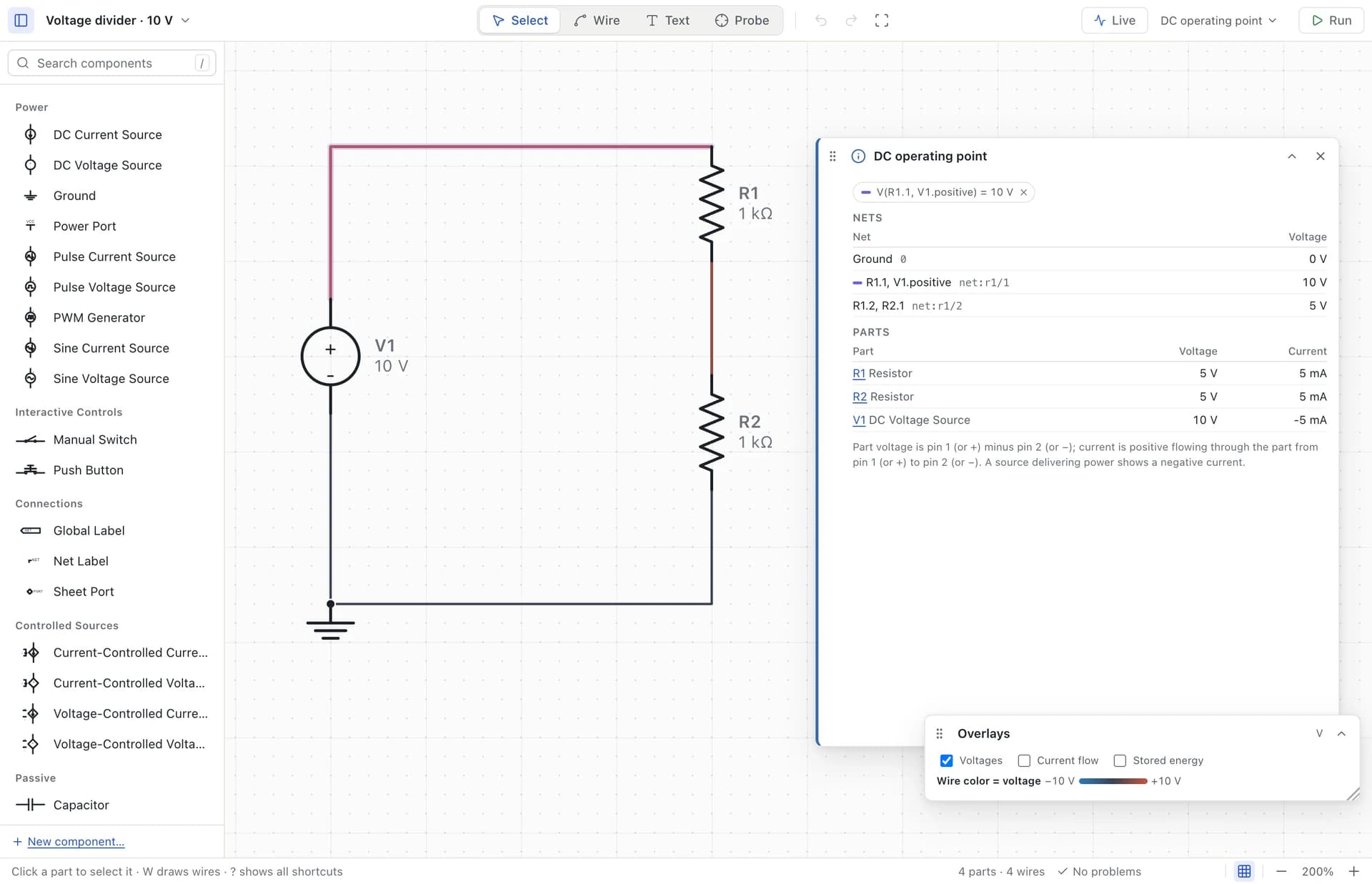
Choose DC operating point and press Run, or use Command+Enter on macOS / Ctrl+Enter elsewhere. Read the midpoint between the two resistors. The captured example reports 5 V and 5 mA through each resistor. Probe a wire with P or inspect the result values alongside the schematic.
A source current may be negative while the resistor current is positive. That does not mean the calculation failed: current signs follow each device’s terminal reference direction. A source delivering energy has negative power under the passive sign convention. Each resistor dissipates I²R = 25 mW, so the source supplies 50 mW in total.
Save the project locally. Change R2 to 2 kΩ and notice that the old results are marked out of date. Predict about 6.67 V and 3.33 mA, then run again. Undo restores the earlier component value; rerun when you want a result for that version.
The useful surprise: a load changes the divider.
Return both resistors to 1 kΩ. Add a third 1 kΩ resistor between the midpoint and ground. R2 and the new load are now parallel, with an effective resistance of 500 Ω. The output falls to 10 × 500 / 1,500 ≈ 3.33 V. The original 5 V prediction stopped being valid because its unloaded assumption stopped being true.
This is why a resistor divider is not a general-purpose regulated power supply. A changing load changes its output. Use the exercise to distinguish a circuit’s topology from the values written on its components: the same two resistor values can give a different output when the rest of the circuit changes.
If your result differs, check the source value, the reference ground and each wire endpoint before changing solver settings. A clean, small circuit is an excellent debugging tool. Next, replace the lower resistor with a capacitor and ask how the answer changes over time.